In this first part, I think out loud about what's in a label.
We have a toy abacus from Melissa and Doug that our 2-year-old (wow, she’s already 2) enjoys playing with. Sometimes I point at a bead and ask her what colour it is, and she enthusiastically responds with “yellow!” or “red!”
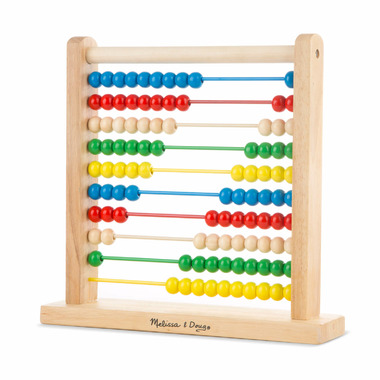
She often tries to quiz me too, and asks “what colour this, daddy?” To which, I sometimes respond with the wrong colour or something categorically wrong like “dog” or “rain.”
“Noooo…. Silly daddy, it’s blue,” she’d say, and we’d laugh.
I remember the first few times I counted the beads. I’d announce loudly as I moved the beads from left to right, one by one: “1, 2, 3…” I did it carefully and watched her reactions. She watched attentively as I did it with the different colours.
I did this with each of the colours - something repetitive that would be boring with my high school kids. I didn’t mind. It was lovely and kind of soothing to count like this, and to watch her tilt her head slightly to the left.
Time sped quickly as I finished all ten beads of different colours. All of the beads are now to the right side. I moved my fingers to begin moving the beads from the right to left this time. Immediately after I said “one…,” she yelled in protest
“Nooo…” She grabbed my right hand with her left and moved the beads back.
I was surprised, but I had a faint idea why she might have done this. I wanted to find out for sure.
“Why?” I asked - something I try to do often with her, even though her responses don’t always make sense. In this case, her response didn’t make sense. But she explained enthusiastically, and made many gestures to the beads, while making several statements confidently (even though I couldn’t understand those statements).
“What is this one?” I tried a different strategy to understand what she meant and pointed at the bead closest to the left.
“Ten.” She announced with a beaming smile on her face.
That was illuminating. It seems that she had associated the numbers with the individual beads. The words with the location of the bead, instead of the quantity. I wondered briefly about how to best approach this. Then I continued onto trying different things.
Words have meaning because we give them meaning.
We have a small dishwasher that we bought a few years ago. It works well for us, since we’re in a small apartment downtown, and there’s just the three of us. Instead of establishing regular chores, my partner and I just do the dishes when we see them (or at least that’s the plan).
Early on in our dishwasher-using life, we decided to use a little magnet to indicate when the dishes were clean or dirty. Magnet on: dirty. Magnet off: clean.
This worked out well. We could put dishes in whenever and be able to do them all together when the little dishwasher is full. Magnet on; magnet off. Dirty; clean.
Inexplicably, I tend to treat the little dishwasher somewhat like a dish rack. I’d still wash most dishes by hand, and then put them in the dishwasher. My partner, on the other hand, treats it more like a dishwasher. She’d rinse the dishes quickly and simply place them in. On; off; dirty; clean. There’s no reason to designate who’s running the dishwasher or not. Or is there?
I was playing with Sophie when my partner loudly exclaimed. She was surprised by the dishes being dirty when she started to unload them. “Did you run the dishwasher?” She came and asked. “No, did you?” I quickly responded, since I recognized that I’ve been terrible with dishes lately.
“Why isn’t the magnet on?”
I tried to think. I probably took it off by accident. Or maybe I put in the first few plates and forgot to put the magnet back on. The reason was lost on me. The magnet was a symbol, a label, for our dirty dishes. Like the bat signal or an ‘SOS’ spelled out with rocks on a lost beach – a cry for help. ‘On’ was dirty and ‘off’ was clean.
But labels have meaning because we give them meaning.
The thinking classroom has been sweeping across the mathematics education community for a while now. Certainly through #MTBoS as well. Alex Overwijk, I, and a few others from Ottawa encountered these ideas from Peter Liljedahl many years ago and began to incorporated these ideas immediately. The elements from the thinking classroom framework has been powerful and transformative for us, and continues to evolve our practices.
A year or two after, the ideas blew up in various places through different forms (twitter, for example). For many, the ideas about the thinking classroom came second hand. Either through Al’s sessions at TMC that one year, or elsewhere.
For some, it was met with enthusiasm: another strategy to try; more stories of success to replicate; can’t be hard to start. For some, it was met with skepticism: another silver bullet; more so-called experts ramming ideas down our throats; can't work for my students.
I find both enthusiasm and skepticism important, but the attitudes can be troubling.
Enthusiasm is good, but it requires that we put ourselves in it. It’s good to take risks and try different things in our practice. It’s not good to think of ourselves as soulless puppets that channel, for example, 'the thinking classroom'. In passing, I’ve often heard similar sentiments: “Oh, I’m doing a Dan Meyer today” or “That was a Marian Small lesson.” You cannot be anyone but yourself. I attempted to illustrate this with a spoken word piece during my ignite. You cannot, and should not, be anyone but yourself. I mean, what exactly does it mean to be doing a 'Dan' or 'Marian' anyway? Detailed answers would probably differ from person to person anyway. Let's not reduce their work to broad strokes.
Skepticism is good, but it requires investigation and exploration. It’s good to reflect on the things we try and to think critically about the why, how, what, when, and where’s. It’s not good to reduce other people’s stories only to ideas we recognize. “Spiralling,” for some, has been reduced to simply doing random topics throughout the year. The “thinking classroom,” at least for some, has been reduced to students using whiteboards. This is a shame. Since if that’s what you believe it to be – then that’s what it will be. Personally, I've found it helpful to try to draw connections no matter what ideas I encounter. Whether something is useful to my practice - is up to me.
Similar to what I wrote before about the damages caused by the metaphor of the pendulum, I shout this from this virtual rooftop:
Word have meaning because we give them meaning.
Labels have meaning because we give them meaning.
The thinking classroom, as Peter has pointed out every time he facilitates a workshop, is brimming with complexity and diversity. It is a structure, from which we build ourselves, pose our questions, and involve (and evolve) our experiences and expertise.
Yes, students use VNPS in VRG every day, but that’s only the beginning. These are designed to shatter institutional and (seemingly) non-negotiated norms in our classrooms. But there so much more than this. I mean, what happens when you smash these norms? Of course we would need to rebuild!
Our teacher moves still matter. Our teacher moves are still what makes the difference as we build our worlds with our students.
Our world has meaning because we give it meaning.

No comments:
Post a Comment